 Helpline : 7880161616
 WhatsApp


About the Department & USPs
Welcome to our Orthopaedics department, where we provide exceptional care for musculoskeletal conditions. Our team of skilled orthopaedic specialists is dedicated to diagnosing, treating, and rehabilitating patients with a wide range of conditions affecting bones, joints, muscles, ligaments, and tendons. We offer personalized treatment plans tailored to each patient's unique needs, ensuring the highest quality of care and improved quality of life.
Conditions We Treat
Our Orthopaedicians, provide you with the best medical choices to prevent or treat many conditions, including:
- Fractures and trauma
- Arthritis
- Osteoarthritis
- Sports injuries
- Pain & Movement Disorders
- Joint disorders (hips, knees, shoulders, ankles)
- Tendon and ligament injuries
- Osteoporosis
- Bone & Joint Infections
- Scoliosis and other spine deformities
- Musculoskeletal infections
- Carpal tunnel syndrome
- Rotator cuff injuries
- Rheumatoid arthritis
- Bursitis
- Tennis elbow
- Plantar facilities
- Bone Disorders
- Congenital Bone defect & Injuries
- Gout
- Congenital Talipes Equino Varus (CTEV)
- Developmental Deformities
- Osteoporosis
- Bone Tumors
- Frozen shoulder
- ACL Tear & PCL Tear
- Osteomyelitis
Caring Hands
- Orthopedic Surgeon
- Orthopedic Specialist Nurse
- Orthopedic Physical Therapist
- Orthopedic Rehabilitation Specialist
- Orthopedic Surgical Technologist
- Orthopedic Trauma Surgeon
- Pediatric Orthopedic Surgeon
- Sports Medicine Orthopedic Surgeon
- Orthopedic Oncologist
- Orthopedic Spine Surgeon
Robotic Joint Replacement Surgery in Bhopal | Mako Robotic Surgery at SMH
Living with persistent knee pain, difficulty walking, climbing stairs, or joint stiffness can significantly impact your quality of life.
Robotic-assisted surgery at Sagar Multispeciality Hospital offers a precise and personalised solution for patients requiring joint replacement.
Through advanced 3D imaging, customised surgical planning, and enhanced surgical accuracy, robotic technology helps optimise implant placement, minimise tissue disruption, and support a smoother recovery journey.
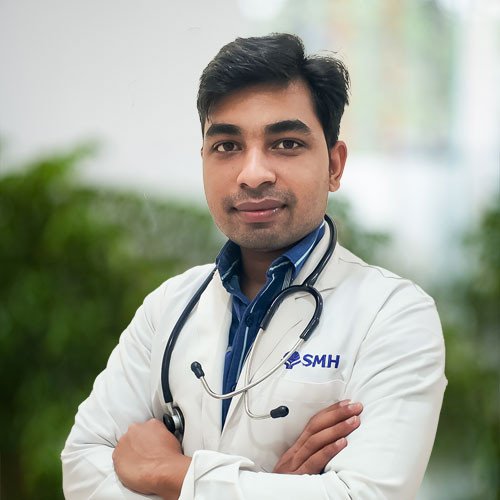
Dr. Amit Tandiya
Consultant, Orthopaedics & Trauma Services
Department
Orthopaedics, Joint Replacement & Sports Injury
Expertise
Hip & Knee Joint Replacement, Robotic Joint Replacement Surgery, Advanced Arthroplasty, Orthopaedic Trauma Management, Foot & Ankle Disorders, Joint Reconstruction Procedures, Arthritis & Joint Pain Management, Evidence-Based Orthopaedic Care

Dr. Manoj Nagar
Senior Consultant, Orthopaedic, Sports Injury and Arthroscopic Services
Department
Orthopaedics, Joint Replacement & Sports Injury
Expertise
Primary and Revision Hip, Knee and Shoulder Replacement Surgeries | Arthroscopic Surgeries of Shoulder and Knee | Complex Trauma Surgeries

Dr. Raghavendra Sharma
Consultant, Orthopaedics & Trauma Services
Department
Orthopaedics, Joint Replacement & Sports Injury
Expertise
Complex Trauma and Spine Disorders
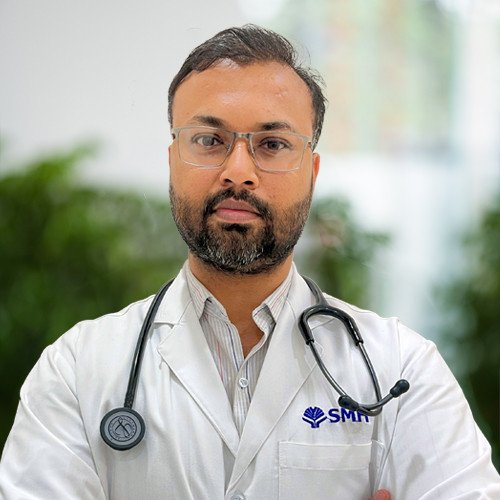
Dr. Vaibhav Jain
Visiting Consultant, Spine Health & Surgery
Department
Orthopaedics, Joint Replacement & Sports Injury
Expertise
Spinal disorders, Back pain, Neck pain, Herniated disc, Sciatica, Scoliosis, Spinal stenosis, Degenerative disc disease, Kyphosis, Lordosis, Osteoporosis, Spinal fracture, Radiculopathy, Cervicalgia Lumbar strain, Sacroiliac joint dysfunction, Thoracic outlet syndrome Cauda equina syndrome, Ankylosing spondylitis, Vertebral compression fracture, Endoscopic spine surgery

Dr. Yogesh Patel
Consultant - Orthopaedic and Paediatric Orthopaedic Services
Department
Orthopaedics, Joint Replacement & Sports Injury
Expertise
Congenital Anomalies - Clubfoot | Pediatric Trauma | Foot & ankle Deformity | Pediatric Hip Condition | Sports Injuries | Cerebral palsy | Bony Deformity - Knock Knee etc
Technology has had a significant impact on orthopedics and joint replacement surgeries, revolutionizing diagnosis, surgical techniques, and post-operative care. Here are some examples of technologies commonly used in orthopedics and joint replacement:
- Imaging Technologies
- Computer-Assisted Surgery (CAS)
- Rehabilitation and Assistive Technologies
- Navigation Systems for precise bone cuts, accurate alignment, and implant positioning
- Minimally Invasive Surgery (MIS) to reduce post-operative pain, speeds up recovery, and lowers the risk of complications
- Smart Implants and Wearable Devices to monitor implant stability, load distribution, and range of motion
Knee pain while climbing stairs is usually because of early arthritis, cartilage damage, ligament injury, or muscle weakness in the knee joint. It may also be due to weight gain, injury, or ageing. Early management with medications, physiotherapy, knee support, and modification of lifestyle usually provides relief.
Back pain caused by prolonged sitting is usually experienced because of poor posture, muscle strain, or disc problems. Maintaining a healthy posture through posture breaks, stretching exercises, and exercises that strengthen the core muscles can help. However, if the pain radiates to the leg or causes numbness, a doctor’s check-up may be required.
Frozen shoulder gives a person pain in the shoulder region, stiffness, and difficulty in raising the arm or reaching behind the back. This condition is common in people with diabetes or as a result of injury. Physiotherapy, exercises, and injections are used to regain movement. Most patients get better in a few months.
If there is a fracture, it is essential to keep the affected area still, apply ice to prevent swelling, and seek immediate medical attention.
However, it is important not to attempt to straighten the bone yourself.
In children, it takes 4 to 6 weeks for the bone to heal, whereas in adults, it takes 8 to 12 weeks or even longer. Eating healthy food, taking calcium, and physiotherapy can aid in the healing process and prevent stiffness.
Knee replacement surgery may be recommended if arthritis leads to severe pain, walking difficulties, disrupted sleep, and limited activity despite taking medications, injections, and physiotherapy. At SMH, our orthopaedic team carefully evaluates each patient and recommends surgery only if it will make a substantial difference to their mobility and lifestyle.
Hip replacement surgery is very successful in relieving pain and restoring mobility in patients with arthritis or hip damage. Patients are usually able to walk with assistance within a few days of surgery and can then continue their recovery with directed physiotherapy.
Joint replacement surgery is relatively safe, and at SMH, we adhere to strict infection control and monitoring measures to ensure safety. With proper pre-operative assessment, our high standard of surgical care, and our in-house rehabilitation and physiotherapy services, patients can expect a smooth recovery and regain their mobility with confidence.
A torn ACL often results in swelling, instability, or the knee buckling when walking or running. An MRI scan can confirm the torn ligament. Physiotherapy or surgery may be required, depending on the patient’s level of activity and the severity of the injury.
Osteoporosis is a condition in which the bones become weak and are susceptible to fractures. Walking, exposure to sunlight, calcium, vitamin D, and medications if necessary can help keep the bones strong, especially in older people.